Monday, 15 April 2013

The Source Of The Rile

So the seemingly relentless easterlies have finally turned and the warmer kiss of the westerly breeze this weekend chased Jack Frost from my Norfolk hinterland .. hopefully not to return now until theres a 'v' in the month. This mornings walk out with the air rifle and lurcher saw me with two layers less, no gloves and a coating of DEET .. the shooters 'eau de cologne'. The westerlies, when they arrived, brought moderate rain on their front. They usually do. The combination of warm air and precipitation tickled the time-clock of a million hidden larvae. It always does. And so, as the hound and I tracked out through the forest toward the Source of the Rile, it was a through swarms of gnats and midges.

Not that I was complaining too much. That overnight rain had undone the harsh work of those persistent easterly winds, which had left the leaf mulch on the woodland floor so arid of late, stalking was akin to dancing in a vat of potato crisps. Today, I had the luxury of a damp, deep natural carpet. All I had to do was avoid the twigs. But why the need for such stealth? Because we're hunting, my 'dawg' and me. We're searching for the Source of the Rile. A vital mission, to be taken with all seriousness, lest we lose our precious hunting land. The phone call had come mid-week from the irate land-owner. "There are far too many grey squirrels about, Ian". I didn't argue .. there are feckin' thousands of them in Norfolk! "They are decimating my bird feeders. What are you going to do about it". It wasn't a question. It was an order. "Best I come over and shoot a few, sir?" I suggested. "Best you do, young man! I am extremely riled!" I was going to mention that I don't actually get paid to do this, by him, but thought better of it. His is a pleasant little estate and provides great sport for an air-gunner. I am aware, too, how many other air-gun shooters would love this permission.

So here we were. I knew, as we stole into the wood, the position of every drey in the copse at the end of this gentleman's garden. There were far fewer live ones than he imagined. I settled the dog into a 'lay' position next to me beneath. We watched the tree canopy, both of us. Not hard, as the leaves have yet to bud. Dylan would be my radar, my eyes and ears, for he can sense a grey squirrel at 100 yards at the mere twitch of its bottle-brush tail. He is infallible, a legend, written about in two books and a myriad magazine articles. Not! As we both stared tree-ward, a grey squirrel scampered from behind the tree ten feet to out right, froze in the open as it sensed us, considered it's future carefully and sprinted back. As I fumbled to raise the rifle, the lurcher dis-obeyed every rule in the "How To Keep My Master Happy" book and went after it. The critter went up the trunk, the lurcher went behind the trunk and I went ballistic. "Get your bl**dy *rse back here!" I screamed. Which obviously agitated the squirrel more than him and it set off across the boughs. 1-0 to the grey squirrel population and a legendary lurchers career lay in tatters. He trotted back and settled down again on the floor at least two 'kicks' away from my position. Wisdom comes with sore experience.

Still relying on him to indicate 'incoming' I kept half an eye on his demeanour. When he sat up, looking across the woodland floor with his head tilted and ears flapping, I came alert. He kept looking back at me, quizzically. I followed his gaze and I, too, was confused. Nothing! Then I noticed what he was seeing. Small flicks and jumps amongst the leaf mulch. First I saw a couple then, as my eyes focussed on that level, I became aware that were dozens of movements. Then, dozens and dozens! I looked around and we were in the midst of a sea of migrating common toads. They were moving from the gentlemans garden ponds down to the stream and large pond at the edge of the copse. Some were coupled, mating, others were solo. Amazing.

We moved away, so as not to disturb them. Further up the wood, Dylan tuned into Channel Grey eventually and we took out a few of the squirrels exiting the bird feeders next to the manor house. Caught in the act, so to speak. As I sat under an ancient yew tree, trimming the tails from the greys, I sensed I was being watched. Glancing up, my stare was returned by the face of a little owl scowling down at me from not six feet above my head! I slowly reached for my ever present camera but when I looked up again, she was gone.

I took the tails and hung them in a plastic bag on the gentleman's garage door. He would use these when tying flies for his fishing hooks. Now he could, in all likelihood, complain that I'd only shot two? And I could retort that they were the two actually raiding his feeders today. If he phones though, I would be more likely to say that I only chose to leave him the two for his fly-tying. I needed the other ten for my own purposes. (Wink, wink!)


Friday, 5 April 2013

A Tale Of Two Books


When I sat down to write my first book about airgun hunting a few years back I had no idea how long the publishing process takes. Like most budding authors, I assumed that if a publishing house accepted your work they would rush it onto the bookshelves before a rival publication appeared. Having agreed a contract, I was a tad frustrated that I wouldn't actually see the printed book for nearly two years! Most publishers have a queue of 'work in progress' and the mechanics of constructing a book, editing, approving photographs, passing back and forth copy for approval and finally printing it .. are time consuming. If I was impatient with the process, I was absolutely delighted with the end result when Merlin Unwin sent across the first print of 'An Airgun Hunters Year'. I can't describe the pride you feel turning over a book in your hands, with your name on the cover as author. It is a sublime moment .. like holding your new born baby in your hands.

That first book was presented by Merlin Unwin and Karen McCall in exactly the way I had conceived it. I hadn't wanted my first book to be a 'how to' manual. There were already several airgun books of that ilk. It is a book that was written (like my magazine articles) with the intention of drawing the reader deep into the countryside alongside me to touch, taste, hear and smell the ambience that surrounds the true hunter. A celebration of life, not death.  A book that would explain the importance of conservation, species preservation and crop protection. I also wanted to convey the value of recycling shot quarry and so the book contains simple recipes. I even indulged myself with poetry based around an autobiographical figure .. The Hunter.  

My second book, produced by Blaze Publishing (also publishers of Airgun Shooter, a magazine I write for monthly) was definitely a deliberate 'how to' publication. Yet I was determined to stick with the descriptive flow and written 'picture-painting' that readers tell me they enjoy in my magazine work. Airgun Fieldcraft gave me the opportunity to bleed myself .. to impart hundreds of small tips, tricks, observations, facts and theories that I've absorbed or used to my advantage in over 30 years of small vermin shooting with air rifles. Rather than poetry, I wrote at the start of each chapter a 'visualisation' from the quarry's perspective .. life through the eye of the creature .. which I enjoyed doing. Again, the book contains recipes and (as with book one) it allowed me to showcase my other passion, photography.

Will there be a book three? Of course there will. Writing, for me, comes with supreme ease. I find it relaxing and only rarely stressful (such as when I have a deadline!). It is addictive .. but I haven't decided on which project (I have several in mind) I want to tackle next.

If you fancy a trip through Ian Barnetts' Norfolk countryside, if you like a poem or want to imagine what it's like to be a crow or a rat, if you want a tasty recipe for wood pigeons, details on how to purchase my books can be found on my website or Facebook page. Just tap on the links below.


Friday, 29 March 2013

An Easter Reflection


Don't tell anyone will you? I saw a very rare mammal in a field North of Norwich this morning. I raised my rifle to cull it but stayed the shot. Then I saw a few more. Still, I was reluctant to shoot. It wasn't a native British animal although rumour has it that it was once extremely common in the British countryside. Introduced from Europe by the Romans (or was it Normans .. much historic debate about this) it took a foothold in these in isles that changed the landscape. It dug and burrowed, opening out areas of heathland and stripping sapling copses. Over hundreds of years it nibbled our grazing pastures, undermined our railway embankments and fornicated its way into legendary numbers.
From the middle ages, up until last century, it was even farmed for its meat and fur. It became the staple food of the peasant, the badger, the fox and the buzzard yet its penchant for agricultural damage made it many enemies. It became hunted with hound, ferret, net, gun, hawk and snare. Yet still its fecundity outran its persecution. Then, in the mid-twentieth century it was dealt a shameful blow. Biological warfare. The deliberate introduction of a species specific virus called myxomatosis, developed by our Antipodean brethren (whose vast sheep farms were swarming with the pest). The virus became a plague and millions of these small mammals stumbled around the countryside sick and blinded by the mucus caking their sad brown eyes.
Nature, though, has a wonderful knack of standing on the opposite side of an unfairly weighted scale. Gradually, the surviving creatures developed resilience to the virus .. though rarely immunity. To this day the myxomatosis virus swims in the blood of the flea, the mosquito and the tick to randomly attack colonies of our mystery animal. Many now survive the disease but will bear the scars of its attack.
More recently, another alleged 'manufactured' disease was let loose on our humble mammal. VHD (Viral Haemorrhagic Disease) has attacked colonies throughout the UK. Unlike 'myxie', we rarely saw the victims for they simply bled to death within their burrows. All we noticed was the sudden lack of sightings of the beasts. Yet still .. our animal continued to rise in numbers. Good news for the hunter, the badger, the fox and the buzzard. Free food for all. In fact, so prolific was its breeding two or three years ago I was shooting even its kittens all year round to control numbers.
Then suddenly, last year, Mother Nature dealt an unusually bitter blow. Perhaps she thought that the badger and the fox were having far too easy a life due to the interference of man? Certainly these large predators have never enjoyed such a prolonged period of enforced protection .. their numbers spiralling out of control. It's often said that Nature abhors a vacuum, yet she also detests a glut .. and moves swiftly to redress the balance. What better way than to reduce the primary food source? An act of retribution she unleashes globally with her proclivity for creating famine, pestilence, flood, catastrophe and fire.
Last autumn and over this winter she let loose the power of precipitation. To put it bluntly, it pissed down for months. Water tables rose across the UK, thousands of square miles of land were flooded (many still are) and the ardour of our little agricultural pest was somewhat dampened. Nor did it have anywhere to delve and nest. This effect cascaded upward in the food chain too. I haven't seen a single fox cub on my shooting permissions so far this year.
So this morning I was mightily relieved to see the return of an animal I haven't shot for nearly four months .. and nor will I until I see numbers that indicate the flush of revival. The creature? Well, you've guessed of course.
Happy Easter, Mr Bunny!


www.wildanglia.co.uk
www.facebook.com/wildanglia

Sunday, 24 March 2013

Hunting Heffalumps (with apologies to AA Milne!)


As we set across the open service track between the farm buildings and the sixteen acre coverts, the bitter Easterly wind picked up the nights light dusting of snow and whipped it in tiny eddies across the frozen plough. The lurcher cast into the breeze, his light, rough coat swept horizontal by the wind. Not gusting but constant, this Arctic-born zephyr cut like a knife, bringing tears to my eyes. We hurried over the white mile, man and dog eager to reach the relative shelter of the wood, paws and boots cracking the fragile ice covering the puddled tractor ruts.

Inside the wood we were to meet disappointment. The cold wind chased us mercilessly and sent her icy sprites dancing among the pine boles to bite the exposed skin. I was well wrapped in micro-fleece and sub-layers of cotton but the imps soon found my cheeks and trigger finger. Thankfully I had a Zippo hand-warmer cooking in my pocket to relieve the latter. The lurcher had scant protection. Not much meat on this little bag o' bones running machine and he kept stopping to nip the balled up ice gathering between his pads. I pulled the fleece snood up to cover my chin and set off deeper into the wood. This was a day to keep moving.

Pretty soon I noticed the tracks of a single beast impressed in the shallow snow ahead of me. The dog had his snout down and was following them keenly. Huge prints, padded and clawed. Twice the size of the dogs. All those speculative stories about big cats in this area of Norfolk immediately leapt to mind. Having little other purpose this morning (any sensible vermin being holed up in burrow or drey)  I decided to follow them for as far I could. I knew what the beast was, of course. I've been tracking animals for too long to be fooled by these prints. Nonetheless, there was fun to be had here. Here we were, my hound and I, in the sixteen-acre plantation playing at being Piglet and Pooh  .. on the trail of a Heffalump!

The trail followed along a man-made ride pretty rigidly, though now and again I could see where the mythical beast had veered off to scent and spray. The pheromones of that spray sending a shiver of caution through Piglet, my lurcher. His fear was palpable, yet he bravely nosed on. We both jumped, hearts in mouths, when a red stag leapt up from cover and called its two hinds up behind him. The huge deer leapt to safety, his harem following, as the dog stood panting. Eventually the tracks left the path and headed off under bare briar and over sandy hummock, deep into the nether-land of the coverts. This is where Piglet came into his own, following the scent while Pooh could only trust and follow, picking up a print here and there. I was comforted by the regular evidence of snuffling and rooting. Areas of leaf mulch thrown up as the creature had sought slight morsels of food which could surely never satisfy its bulky frame? This was a big beast, needing substantial feast.

I never expected to meet this particular Heffalump face to face so I carried no fear in the hunt. I knew he was a creature of the night. Thus, it was no real surprise when Piglet finally led me to the mouth of the Heffalump den. A hole so large the dog, standing 24" at the shoulder, could almost enter if he dared. The dogs nose pulled him inward, curiosity mixed with fear but he soon retreated. It was almost as though he could visualise the cast iron claw and the vicious tooth of the beast. He withdrew a distance, bidding me ( with his whine) to come away too.

As we left the lair of the Heffalump, we followed the tracks made as it had exited the nest at the start of its nocturnal expedition. Just like Pooh and Piglet, we followed them around to where we had first seen the trail .. full circle. Now a foolish hunter could have been tricked into thinking that at this point, the creature had been joined by a man and a dog .. and gone around the trail again.  Heffalumps always seem to hunt in circles. So do badgers. Could our beast have been a badger? Well, possibly it could have been a massive boar badger, with tracks like that? But I'd like to think that I'd found a Heffalump lair. What do you think?

 
If you like this, check out my books and my writing in Airgun Shooter and The Countrymans Weekly
and take a look at my sites:
 

Friday, 22 March 2013

Snapshot Shooter


I've been submitting articles to the country sports press for about eight years now and I'm often asked how I get the photographs to accompany my pieces. I think the old joke (published in my first book) that I've trained my lurcher to take the pics has worn a bit thin. The question of in-field photography was raised again on Facebook the other night, so I thought it wouldn't hurt to give away a few 'trade secrets'. But first, a little history.

I didn't make the breakthrough into regular magazine slots due to my photography. I got into the game through being able to paint a picture with words. In the early days my pics were of random quality and taken just using compact cameras .. even the wildlife pics, which were dreadful. The magazine media, though, is highly visual. It was no fool who wrote 'a picture paints a thousand words'. I've been dead lucky in having an editor (from the start) who is himself an accomplished photographer. Nigel Allen. He encouraged my growing interest in photography and cameras, giving lots of advice along the way. In the early days, Nigel had to post-process my photos massively but he never had to do much with my writing. Now, he has little to do as I send him near perfect post-processed pics and self-edited text (only joking, Nige!). 

Seriously, first tips for submitting to an editor are to make sure the subject is relevant and interesting, text is grammatically accurate, spelling is correct and your pics are as good as you can get with the kit you use. Writing "I went down the wood and shot a rabbit wiv my 22 Beeza and cooked it later" accompanied by a fuzzy pic of a smiling numpty and a bloodied rabbit isn't going to inspire publication. However, " I stole silently from the woods margin and settled between the nettle beds. The movement of translucent ear tips further down the warren brought the .22 BSA Lightning to my shoulder and when the coneys head was clear in the scope, I tickled the trigger. Within seconds, I had the prime ingredient for my Sunday dinner" alongside a subtle photograph of a hunter recovering a (bloodless) rabbit from the meadow is far more likely to attract an editor .. and the reader.

Though I own two DSLRs (Nikon D5000 and D7000) plus a range of lenses, many people would be surprised that I don't use these for general magazine work. It's simply impractical to drag my DSLR's, lenses and associated kit such as a tripod around while hunting. So for hunting forays I travel light and my workhorse camera is my Nikon Coolpix P7100 super-compact. This cracking little 10mp camera shoots RAW files and has all the functionality of a DSLR .. yet fits in your pocket. Attached to my Trek-tech Optera 230 bendable tripod and using a Nikon ML-L3 remote this camera is incredible versatile. I can hang it off tree branches, wrap it around fence posts, stand it on stumps .. the only limit is my imagination. Image quality is superb .. I've even had magazine cover pics from it. In fact it's so good, I own two. I bought another to stow away in case it ever gets discontinued. That tiny Nikon ML-L3 remote control is brilliant for magazine shots as I can pre-programme the shutter timer to 2 or 10 seconds, get into position and snap away at leisure.

If I'm anticipating wildlife photo opportunities I pack the D7000 with a little Sigma 18-250mm zoom attached. Even this adds weight but its manageable when carried on a Black Rapid sling. It can hang loose to bring up quickly for an urgent photo without interfering with my rifle or shooting. There is no room for the Sigma 50-500mm or Nikkor 80-400mm zooms I use when simply snapping wildlife. The latter, a recent acquisition, is the perfect walkabout lens and doesn't break my back on a six or ten mile wilderness hike.


Saturday, 16 March 2013

Sneak-Thieves and Sentinels


At this time of year I will turn my attention .. and my muzzle .. to the magpie and the carrion crow. Mother Nature has a predilection for favouring the strong over the weak. She allows evolution to put one species at advantage over another. These two corvid cousins are a case in point. They are the countrysides earliest risers, out at first light to clean up the carrion left by last nights roadkill or Reynards leftovers. They have another early trait too. Both build their nest, mate and hatch their chicks a couple of weeks before their prey species .. songbirds or gamebirds.

So as the magpie and crow sit aloft their watchpoint with their squeaking fledglings begging for feed, they are plotting and conniving. They note the blackcap cock and hen changing guard over the tiny eggs. They see the cock blackbird carrying grubs to its chicks. They spot the robin stealing into a crevice to tend its mossy bed. They see all and miss little. Both birds are evolved to perfection to snatch, grasp, tear and probe. Their talons match those of the raptors and their vice-like beaks can crack tiny bones or eggshells with ease.

Each of the two has its own 'modus operandi'. The magpie is a sneak thief and coward. It will watch and wait until the parent birds are away from the nest then plunder and murder. A pair of magpies will work the blackthorn hedgerow like a team of pickpockets in a shopping mall. One will decoy, drawing the parent birds away to fuss and harangue. The other will dip in and steal. With deft and cunning, but little confrontation, they will feed their own. The carrion crows are much more brash. They fear nothing but man, so will simply bully in and take whatever they can see. The common denominator for both corvids is the all-seeing eye and the intelligence to hatch a plan.

So .. if Mother Nature gave them the advantage over these weaker species, she also made them one too. She put a rifle in my hands. Targeting each requires a different level of cunning. The carrion crows remote nest in a tall tree is almost impossible to approach undetected. Crows need to be baited away from their nest and ambushed. Never an easy task but an interesting and achievable challenge. If you get one of the pair, you'll rarely get the other!

Magpies are somewhat easier to cull at nesting time. In fact, it's probably the only time of the year that they drop their guard. Just look at the magpies nest. A huge dome of interwoven twigs which involve hundreds of flights from ground to tree by the pair. The pair become so pre-occupied with construction (and probably so weary) that they pay scant attention to their surroundings. The experienced shooter who can get placed within thirty yards of the building site will get ample opportunity to cull at least one magpie. Often, the second too .. for the only time in its life that the magpie drops its cowardly mantle is when its mate or its young are injured or dead.

 Target these two predators now and you will save dozens of eggs and chicks around your shooting beat .. not only songbirds but your landowners game-birds too.


Sunday, 10 March 2013

Deer By Degrees


It was interesting to watch the reaction in the press to this weeks announcement by a group of researchers at the University Of East Anglia (UEA) that some 750,000 deer need to be culled in the UK. Radio Norfolk were among the first to invite open air debate on the topic and ‘yours truly’ was highly amused at the polarised views. Fair play to the radio producers who were prepared to open out a very emotive topic. Dangerous territory on live radio!

Yes, the reaction from the Bambi brigade was wholly predictable. Nothing should ever be culled and wild animals aren’t a lower order than humans. These people obviously know wild animals that develop medicines, design spacecraft and use computers. These 'antis' love to walk in the woods and hug trees but can’t understand that what our friends at the UEA were trying to say is that if we don’t control deer, there won’t be any new woods! But, as the prophet said, there are none so blind as those who will not see.

If that was predictable, I was totally unprepared for the reaction from my own brethren, the hunting and stalking fraternity. Their reaction was incredulity (at the numbers mooted) and a high degree of suspicion. It’s not every week that academics step forward and say ‘please go forth and shoot’. A fact widely stated by shooters yet perhaps missed by the media was that, by and large, the rural deer population is well controlled. Farmers and landowners (including a certain Mr Brian May, allegedly!) give stalking permission to keep deer herds in check .. and healthy. The problem, the root of the UEA research deduction, is the urban and suburban deer population. Yes .. just as with foxes .. our public parks, shrubberies, cemeteries and amenity woodlands are stuffed full of deer. Roe and muntjac mainly, but also fallow and sika. Less so the magnificent red deer. These can’t be easily controlled as few Local Authorities are prepared to permit shooting and even if they did, many of these areas would be unsafe for small-bore rifle work. A fox is small enough to trap and deal with away from the public. A deer isn't.

The interviews I heard with the UEA research team mentioned the deer versus traffic problem. I wonder how many of the general public have had an 'altercation' with a roebuck? Not something I have personally endured yet but I know several people who have and I’ve seen the results. Norfolks major roads are littered every day with deer casualties. Human victims are more frequent than we appreciate .. including occasional fatalities .. yet even I would advocate that this is no excuse for a cull. Nor would I deny, however, that the simple laws of mathematics say more deer, more road deaths? Stands to reason. No .. the real reason for controlling deer numbers has to be habitat and environmental protection. I could walk someone around my shooting permissions (where deer are culled) and demonstrate the point but unless they really understand Mother Nature (and few anti's do) then it would be pointless.

Now .. that report emanated from a campus on the edge of Norwich and I could almost, tangibly, hear the ripple of cynicism from the shooting and stalking community asking for credentials? Relax, guys and girls. The UEA is an internationally recognised centre of environmental excellence. I have some professional involvement (in the day job) with the campus and can vouch for its ethos. Environmental protection balanced against sense and practicality. This report, to me .. a hunter .. reflected that ethos. There is no room for sentiment when dealing with environmental threat. Whether the threat is to a land-mass, an eco-system, a vulnerable species or a humble songbird we humans, the higher order .. there I said it again .. have the power, the intelligence and the resource to intervene. So intervene we must. If we fail in that duty, then we have failed Mother Nature .. who blessed us with that power.


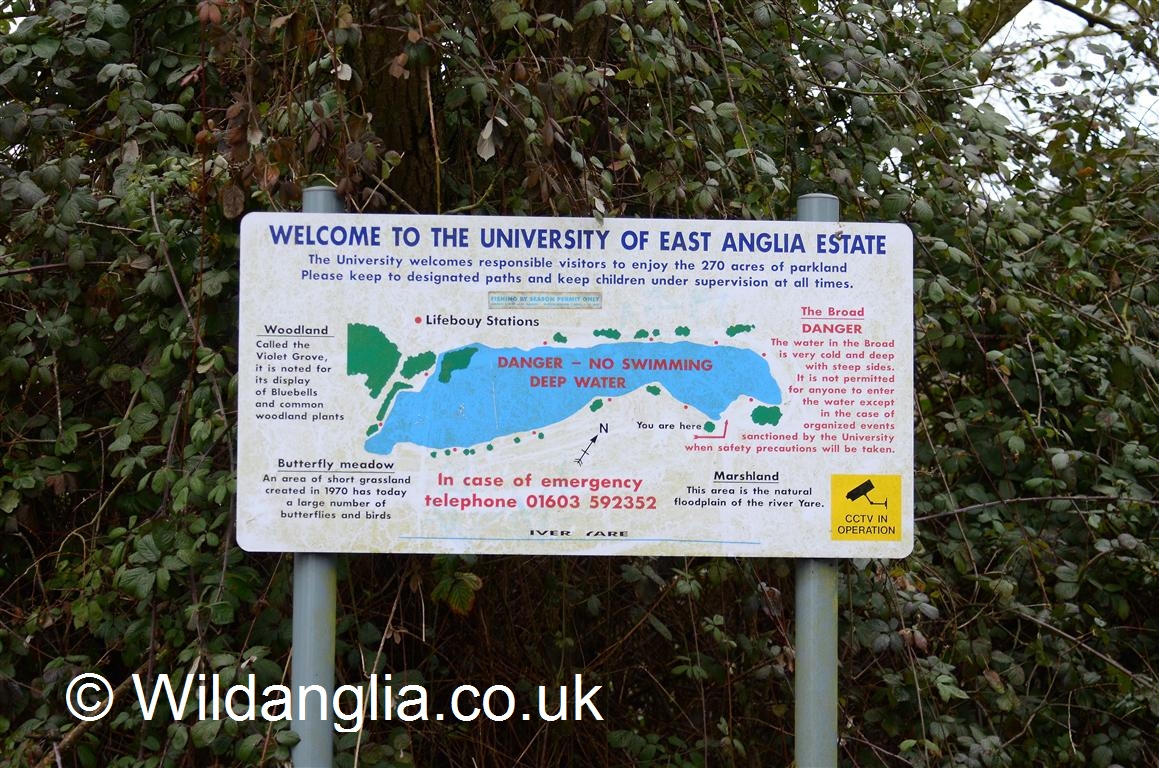
I live fairly close to the UEA. Its estate, bordering the River Yare, is managed as an environmental delight too. Too many rabbits, grey squirrels and magpies for my comfort but, hey, what the hell! All of the photos attached (except the deer ones) here were taken on a walk around its woods and waterways today. Enjoy .. and love those academics and their students. They are studying and lecturing to save our planet .. and quite obviously with a very commendable lack of bias.